How to Remove Carpet Stains Without Damaging Your Fibers
Something spills. You grab a towel, you scrub, and the stain gets bigger. This happens to almost everyone. The good news is that most carpet stains come out just fine when you know what to do in the first few minutes. The bad news is that a few common tricks people find online can damage your carpet forever. Here is a simple guide to both.
Why stains stick in the first place
Carpet fibers are not flat. Up close they look like tiny ropes with open spaces between them. When you spill something, the liquid slides down those spaces and sits at the base, where you cannot see it.
Stains fall into three simple groups, and each one behaves differently:
- Sugar and food stains. Juice, soda, coffee and wine. These dry into a sticky layer that grabs dirt. The spot looks darker over time because it is collecting dust, not because the stain is spreading.
- Oil and grease stains. Butter, makeup, lotion. Water alone will not touch these. Oil and water do not mix, so you need a little soap to break the oil apart.
- Protein stains. Milk, blood, pet accidents. These are the tricky ones. Hot water cooks protein and locks it into the fiber. Always use cold water on these.
Knowing which group you are dealing with saves you a lot of guessing.
Three rules that matter more than any product
Act fast. A fresh spill sits on top of the fiber. After a few hours it soaks into the backing underneath. Fresh spills are easy. Old spills are a project.
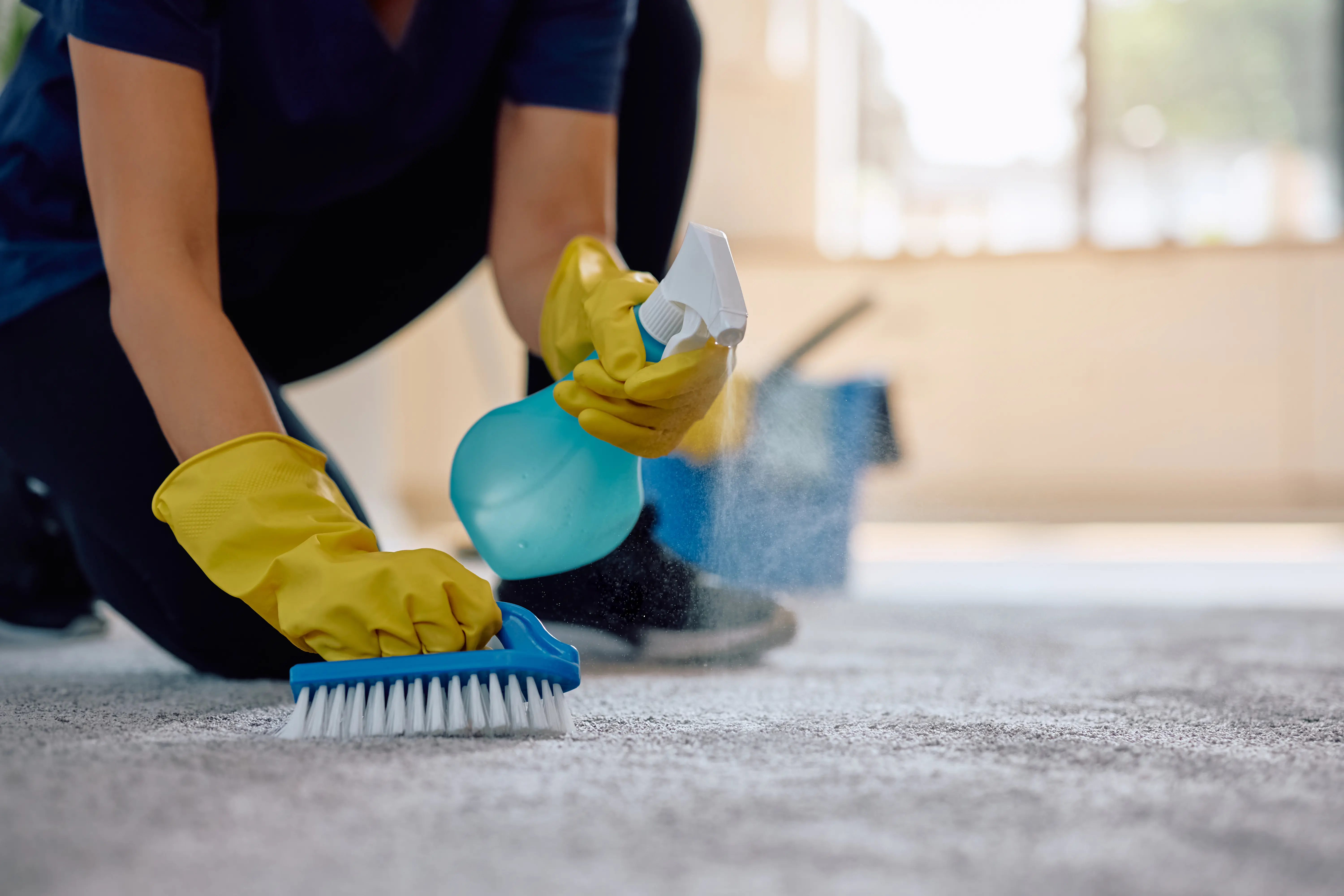
Blot, never rub. Rubbing pushes the spill deeper and breaks the fiber, which leaves a rough, fuzzy patch that stays visible even after the color is gone. Press a clean white cloth straight down, lift, move to a dry part of the cloth, and repeat.
Work from the outside in. Start at the edge of the spot and move toward the center. If you start in the middle, you push the stain outward and make it wider.
Safe things you can try at home
For most fresh, light stains, this is all you need:
- Cold water and a clean cloth. Try this first. A surprising number of fresh spills come out with nothing else.
- A drop of clear dish soap in a cup of cold water. Good for food and grease. Use very little soap. Too much leaves a sticky film that attracts dirt and makes the spot come back darker.
- White vinegar mixed half and half with water. Good for coffee, tea and light pet spots. Let it sit for five minutes, then blot.
- Baking soda. Sprinkle it on a damp spot, let it dry fully, then vacuum. It pulls out moisture and smell.
Two habits to build. First, always test your mix on a hidden corner, like inside a closet, and wait ten minutes to see if the color changes. Second, use as little liquid as possible. Soaking the carpet pushes the stain into the padding below, where it can grow mold and come back weeks later.
When to stop and put the bottle down
Some things do real damage, and once the damage is done, the only fix is replacing the carpet. Do not use these:
- Bleach or any product with bleach in it. It strips the color out permanently and leaves a pale patch.
- Ammonia on wool carpet. Wool is a natural fiber and ammonia breaks it down.
- Hot water on milk, blood or pet accidents. Heat sets protein stains for good.
- Stiff brushes or scrubbing. This shreds the fiber tips. The spot will look worn even after it is clean.
- Rust removers, hair dye removers or paint thinner. These are far too strong for carpet.
Also stop if the stain is older than a few days, larger than your hand, on wool or silk, or if you have already tried two things that did not work. At that point, more attempts usually make it worse.
If you are at that point, do not risk it. Take a look at our carpet cleaning service and let a trained team handle it.
Why professional steam extraction works better
Home methods clean the top of the fiber. That is why a stain can look gone and then reappear a week later. What happened is simple. The stain was never removed. It was pushed down into the backing, and as the carpet dried, it traveled back up to the surface.
Steam extraction, sometimes called hot water extraction, works differently. Hot water and a cleaning solution go into the carpet under pressure, they loosen everything sitting at the base of the fiber, and then a strong vacuum pulls the water back out along with the dirt. The carpet is cleaned all the way down and it dries quickly, usually in a few hours.
Two things make this safer than renting a machine and doing it yourself. A trained team knows how much moisture your specific carpet can take, and professional machines pull far more water back out. Leaving a carpet too wet is one of the most common ways people damage their own floors.
Pet stains need a different approach
Pet accidents are not just a stain. They are a smell problem, and the smell is what brings pets back to the same spot.
Regular cleaners cover the odor for a few days. They do not remove the source, which is soaked into the padding under the carpet. Professional pet treatment uses enzyme cleaners, which are solutions that break down the material causing the smell instead of masking it. Combined with extraction, this removes both the mark and the reason your pet keeps returning to that corner.
If you have pets, you may also like our guide on how to get your pets ready for cleaning day.
Get it done right
Fresh spills are yours. Old stains, pet odor and anything on wool are ours. If you are looking at a spot you have already tried to fix, stop before it becomes permanent.
Get your free quote and tell us what happened to your carpet. We serve Seattle, Bellevue, Kirkland, Lynnwood, Shoreline and the rest of the greater Seattle area, and we will tell you straight if we can save it.
Ready for a fresh start?
Book a Deep Clean
Same-week availability across Greater Seattle.